AI citation tracking
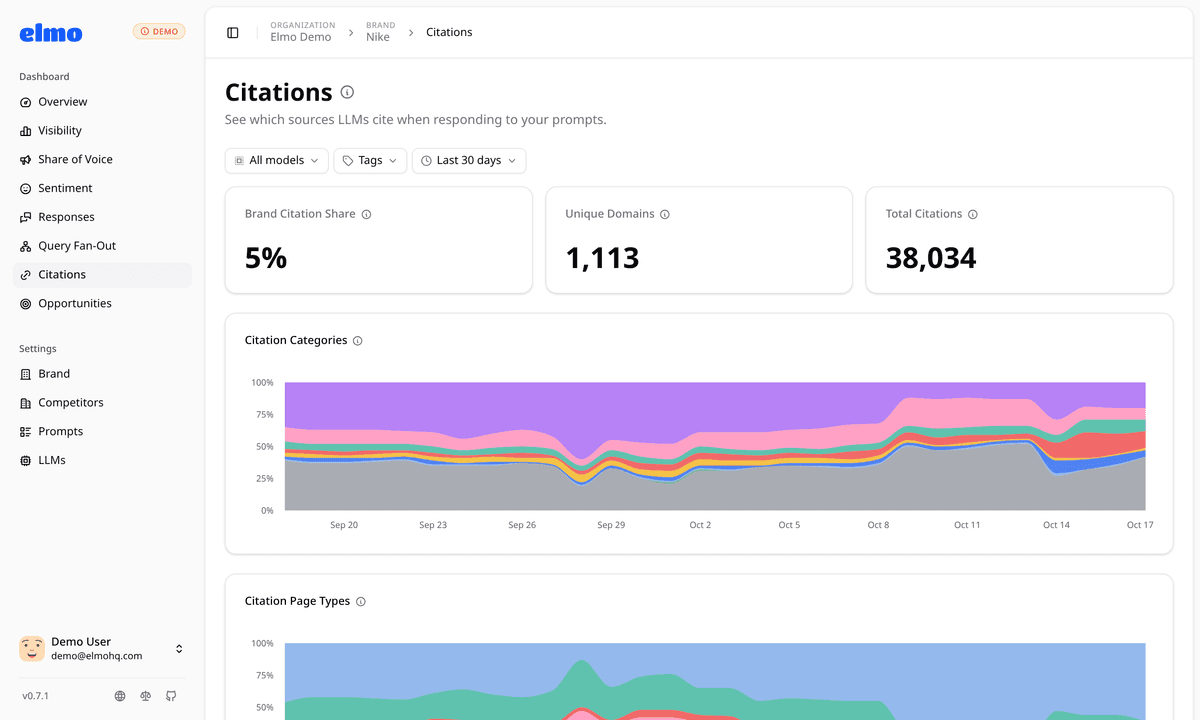
AI answers are built from sources. Elmo records every URL the engines cite for your prompts, so you can see which domains and pages they trust in your category, which of your own pages get cited, where competitors are cited and you aren't, and how the sources shift over time.
What you can do
1See what AI trusts
Rank the domains and URLs AI engines cite most for your prompts, filtered by model, tags, and time range.
2Find your own pages
See your brand's share of all citations and exactly which of your pages are cited, and for which prompts.
3Catch the shifts
Track new and dropped pages and domains, and the prompts where competitors are cited but your brand isn't.
Data you can act on
- Brand citation share
- The percentage of all citations that link to your brand's domains.
- Top domains and URLs
- The sources AI engines cite most for your prompts, with each page's title and type.
- Source categories
- Citations grouped as brand, competitor, editorial, reviews, e-commerce, social, developer, PR, reference, and institutional.
- Page types
- Whether cited pages are articles, listicles, comparisons, reviews, how-tos, docs, forums, videos, and more.
- Recent changes
- New and dropped pages, new and dropped domains, and title changes on cited pages.
- Content gaps
- Prompts where competitors are cited but your brand isn't.
- Reddit and Google Shopping
- Which subreddits get cited, and the products Google AI Mode surfaces from Shopping.
Use cases
- Build an outreach list from the third-party pages AI cites in your category.
- See which of your own pages earn citations, and which never do.
- Find the prompts where a competitor's page is the source and yours isn't, then write the page that should be.
Why Elmo
Categorized for you
Every cited domain is sorted into a category from a maintained list, so you see the shape of your sources without tagging them by hand.
Counted once per answer
A page an answer cites twice counts once, and each prompt citing a page counts once, so popular pages don't inflate the totals.
From the real interfaces
Citations come from the scraped consumer apps where possible, which can cite differently from the same model's API.
Related guides
- DocsCitation analysis docs
- BlogAI citations: what they are and how to earn them
- BlogWhere AI citations come from
- BlogCitation volatility: how much do the sources AI cites change?
- BlogDo AI engines cite the same sources?
- Tool directoryAI visibility tools with citation analytics
- Tool directoryAI visibility tools with content gap analysis
Related features
All features- Query fan-outThe web searches AI engines run behind each answer, and the words they add to or drop from your prompts.
- OpportunitiesContent to create, pages to refresh, and sources to pitch, generated from your own visibility and citation data.
- Share of voiceYour share of AI mentions against every tracked competitor, on a leaderboard, per model, and over time.
Frequently asked questions
Something we didn't cover? Ask the maintainers directly on Discord.
What is AI citation tracking?
AI citation tracking records the sources AI engines link to when they answer a question. It shows which websites shape the answers in your category, and whether your own pages are among them.
Can I see which of my own pages AI engines cite?
Yes. Citations to your brand's domains are grouped as brand citations, and the top URLs list shows each of your cited pages and the prompts that cited them. Add extra domains, like a blog subdomain, in your brand settings.
Which engines return citations?
Engines that search the web, like ChatGPT with search, Perplexity, Google AI Overviews, and AI Mode, cite their sources. A model called through an API without web search returns no citations.
Start winning AI search today.
Start tracking your brand in minutes. Plans start at $29/mo.
- Self-serve
- Unlimited seats
- API and MCP access
Want a walkthrough first? Book a 30-minute tour.