Elmo vs Lettertrace
Elmo and Lettertrace are both open-source AI visibility tools you can self-host and audit. Elmo's focus is transparent, independently verifiable tracking across ChatGPT, Google AI Overviews and AI Mode, Gemini, Perplexity, Bing AI Mode, and Claude — with white-label support for agencies and a documented methodology behind every number.
The short version
Lettertrace doesn't list Google AI Mode, Perplexity, or Grok among its engines and has no MCP server or citation tracking. Elmo has all of that, and it's free to self-host.
Lettertrace appears to be a very early-stage product with limited adoption.
Elmo
Open-source AEO platform. Self-host for free, forever. Track AI visibility across ChatGPT, Google AI Overviews and AI Mode, Gemini, Perplexity, Bing AI Mode, Claude, and more with full transparency.
Lettertrace
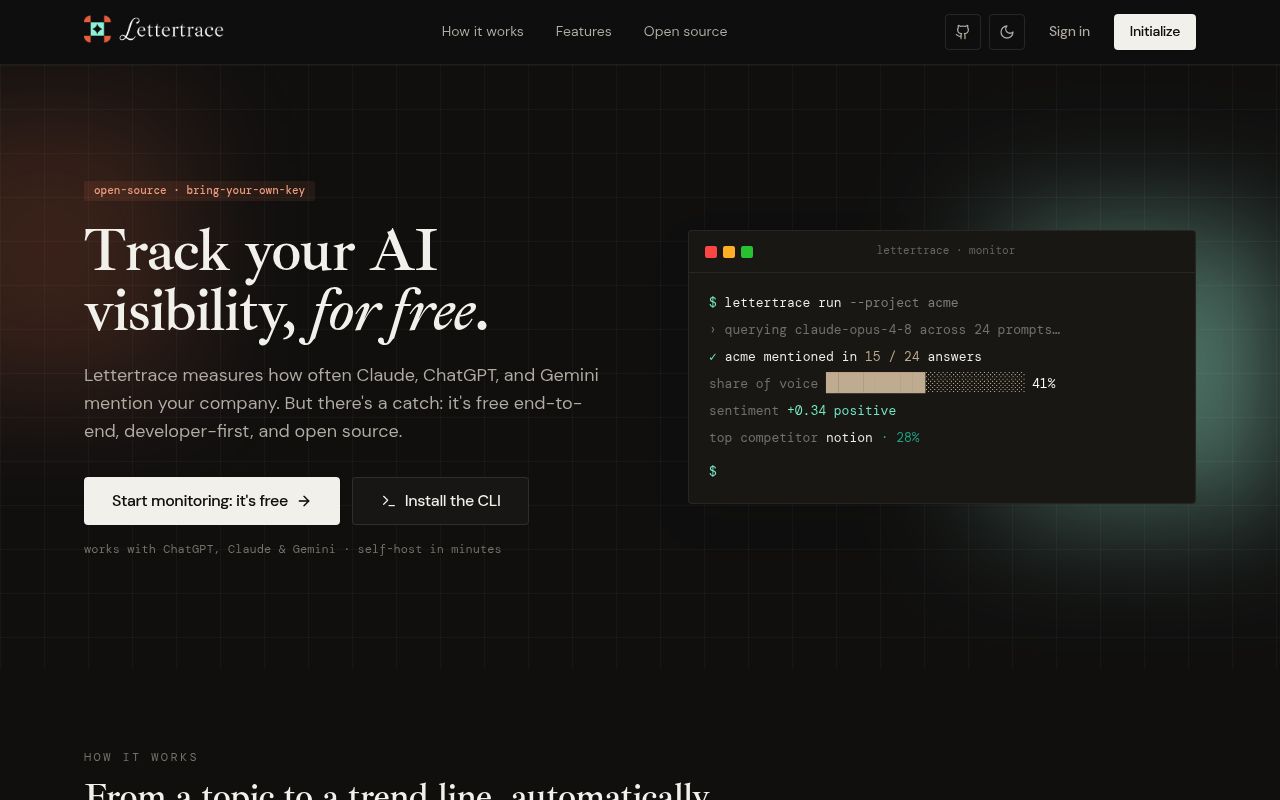
MIT-licensed, bring-your-own-key AI visibility monitor
About Lettertrace
Lettertrace measures how often Claude, ChatGPT, and Gemini mention a brand, reporting visibility, share of voice, prominence, and sentiment per topic and per model over time. It is MIT licensed and self-hosted: you supply your own provider keys and the data stays in your own Supabase instance. A single topic is expanded into prompt variations automatically, and runs can be scheduled daily or weekly from the CLI.
Popularity grade: F
- MIT licensed, free end-to-end, self-hosted in your own Supabase
- Bring your own Anthropic, OpenAI, and Google keys — no usage markup
- Generates prompt variations automatically from one topic
Feature comparison
| Feature | Elmo | Lettertrace |
|---|---|---|
| Core Tracking | ||
| Multi-LLM Tracking | Yes | Yes |
| AI Visibility Score | Yes | Yes |
| Citation Analytics | Yes | No |
| Competitor Benchmarking | Yes | Yes |
| Brand Mention Tracking | Yes | Yes |
| AI Engines | ||
| ChatGPT | Yes | Yes |
| Google AI Overviews | Yes | Yes |
| Google AI Mode | Yes | No |
| Gemini | Yes | Yes |
| Perplexity | Yes | No |
| Microsoft Copilot | No | No |
| Claude | Yes | Yes |
| Grok | Yes | No |
| DeepSeek | Yes | No |
| Meta AI | Yes | No |
| Any Model | Yes | No |
| Real UI Answers | Yes | No |
| Bring Your Own Keys | Yes | Yes |
| Platform | ||
| White-Label | Yes | No |
| Open Source | Yes | Yes |
| Content Generation | No | No |
| Advanced Analytics | ||
| Prompt Volume Estimates | No | No |
| Sentiment Analysis | Yes | Yes |
| Query Fan-Out | Yes | No |
| AI Crawler Analytics | No | No |
| Geographic Tracking | No | No |
| Social Media Tracking | No | No |
| Shopping Tracking | No | No |
| Multi-Language | No | No |
| Actionable Insights | ||
| Action Recommendations | Yes | No |
| Content Gap Analysis | Yes | No |
| AI Site Audits | Yes | No |
| AI Keyword Research | Yes | Yes |
| Reporting & Integration | ||
| Email Alerts | No | No |
| API Access | Yes | Yes |
| TypeScript SDK | Yes | No |
| Python SDK | Yes | No |
| MCP Access | Yes | No |
| BI Connectors | No | No |
We last checked Lettertrace against its own site in Oct 2026. Spot an error? Suggest a correction or edit the data on GitHub.
Key differences
Only in Elmo
- Citation Analytics
- Google AI Mode
- Perplexity
- Grok
- DeepSeek
- Meta AI
- Any Model
- Real UI Answers
- White-Label
- Query Fan-Out
- Action Recommendations
- Content Gap Analysis
- AI Site Audits
- TypeScript SDK
- Python SDK
- MCP Access
Both offer
- Multi-LLM Tracking
- AI Visibility Score
- Competitor Benchmarking
- Brand Mention Tracking
- ChatGPT
- Google AI Overviews
- Gemini
- Claude
- Bring Your Own Keys
- Open Source
- Sentiment Analysis
- AI Keyword Research
- API Access
Why choose Elmo over Lettertrace?
Open source and transparent
Every line of code is open. You can verify exactly how your visibility data is collected, calculated, and presented. No black boxes.
Self-host for free, forever
Run Elmo on your own infrastructure. The core platform is free and always will be, and Elmo Cloud is there if you would rather not run it yourself.
Your data, in your stack
Pull every metric, sentiment included, into your own code with the REST API and TypeScript and Python SDKs, or ask Claude Code and Cursor about it over MCP. Export, fork, or migrate at any time.
Built to last
Bootstrapped and sustainable. No investors pushing towards dark patterns. We'll outlast the companies taking too much VC money.
Frequently Asked Questions
- What is the difference between Elmo and Lettertrace?
- Both Elmo and Lettertrace are open source, so you can self-host either one and inspect the code. Elmo focuses specifically on transparent, independently verifiable AI visibility tracking across every major answer engine, with white-label support for agencies and a fully documented methodology behind each number.
- Is Elmo a free, open-source alternative to Lettertrace?
- Yes. Elmo is a free, open-source alternative to Lettertrace. You can self-host the full platform at no cost, read every line of code, and track your AI visibility across ChatGPT, Google AI Overviews and AI Mode, Gemini, Perplexity, Bing AI Mode, Claude, and more without per-seat or per-prompt fees.
- Is Lettertrace open source?
- Yes, Lettertrace is open source. Elmo is open source as well and is built specifically for self-hosted, independently verifiable AI visibility tracking, so you can audit exactly how each metric is calculated.
- How do Elmo and Lettertrace compare on sentiment analysis, API access, and MCP?
- Elmo includes all three: a 0 to 100 sentiment score for every AI answer that mentions you, a REST API with TypeScript and Python SDKs, and an MCP server so assistants like Claude Code and Cursor can query your data. Lettertrace offers sentiment analysis and API access, but we have not found it offering an MCP server.
- Can I self-host Elmo instead of Lettertrace?
- Yes. Elmo is designed to be self-hosted — deploy it on your own infrastructure in minutes with the CLI. You keep full ownership of your data and prompts, with no per-seat pricing and no third-party dashboard holding your visibility history.
Ready to track your AI visibility?
Deploy Elmo in minutes and start monitoring how ChatGPT, Google AI Overviews and AI Mode, Gemini, Perplexity, Bing AI Mode, Claude, and more talk about your brand.